Can Acne Scars Go Away? Your Guide to Healing and Recovery
Discover if acne scars can fade and what treatments help. Learn how to care for your skin and find out about hidden pore-clogging ingredients.
The lingering marks of acne can be a source of frustration, often reminding us of past breakouts long after the inflammation has subsided. The question, "can acne scars go away?" is a common one, and the answer is nuanced. While complete eradication isn't always possible, significant improvement in the appearance of acne scars is achievable with the right approach and a commitment to consistent, non-comedogenic skincare.
Understanding the different types of acne scars – from the shallow, pitted "ice pick" scars to the deeper "boxcar" scars and raised, hypertrophic scars – is crucial because each responds differently to treatment. Beyond the scars themselves, a consistent skincare routine with products that do not clog pores is the cornerstone of healthy skin. This is especially important as you begin to address acne scars, to prevent further breakouts and allow your skin to heal effectively.
It's also important to understand that patience is key. The skin's natural healing processes take time, and results from treatments are often gradual. Setting realistic expectations and working with a qualified dermatologist will help to manage the process.
Unpacking the Scar: What's Happening Beneath the Surface
Acne scars form when the inflammation caused by acne damages the skin's collagen. The body's response is to produce new collagen to repair the damage, but this repair process can sometimes be imperfect, leading to the formation of scars. The specific type of scar that develops depends on several factors, including the severity of the acne, the individual's skin type, and the body's natural healing abilities.
Types of Acne Scars
Acne scars are broadly categorized into two main types: atrophic and hypertrophic/keloid. Atrophic scars appear as depressions in the skin. Hypertrophic and keloid scars are raised above the surface.
- Atrophic Scars: These are the most common type and include:
- Ice pick scars: Narrow, deep scars that resemble a pinprick.
- Boxcar scars: Wide, U-shaped scars with sharp edges.
- Rolling scars: Wide, shallow scars that give the skin a rolling or wave-like appearance.
- Hypertrophic and Keloid Scars: These scars are raised above the skin's surface and are caused by an overproduction of collagen during the healing process. Keloid scars are larger and extend beyond the original acne lesion, while hypertrophic scars are typically confined to the area of the acne.
Treatment Pathways: From Topical to Advanced
The good news is that there are numerous treatment options available to address acne scars, and the most effective approach often involves a combination of methods tailored to your specific scar type and skin characteristics.
Topical Treatments: Your First Line of Defense
Over-the-counter (OTC) and prescription topical treatments can play a significant role in improving the appearance of acne scars, particularly for milder cases or as part of a comprehensive treatment plan. Look for ingredients that stimulate collagen production and promote skin cell turnover.
- Retinoids: These Vitamin A derivatives are a cornerstone of skincare, promoting cell turnover and collagen production. They can help to smooth the skin's surface and reduce the appearance of scars. Prescription-strength retinoids are often more effective.
- Alpha Hydroxy Acids (AHAs) and Beta Hydroxy Acids (BHAs): These chemical exfoliants help to remove dead skin cells, improve skin texture, and promote collagen production. AHAs like glycolic and lactic acid are effective, as is BHA like salicylic acid.
- Vitamin C Serums: This potent antioxidant can help to protect the skin from further damage, boost collagen synthesis, and brighten the skin.
In-Office Procedures: Taking It to the Next Level
When topical treatments aren't enough, or for more severe scarring, in-office procedures performed by a dermatologist can offer more dramatic results.
- Chemical Peels: These treatments use chemical solutions to exfoliate the skin and promote collagen production. The depth of the peel can be customized to address different types of scars.
- Microneedling: This procedure uses tiny needles to create micro-injuries in the skin, stimulating collagen production and improving skin texture.
- Laser Resurfacing: Lasers can be used to target specific types of scars, such as boxcar scars or hypertrophic scars, by removing the damaged tissue and promoting collagen remodeling. There are two main types: ablative lasers (which remove the top layer of skin) and non-ablative lasers (which heat the underlying tissue).
- Dermal Fillers: For certain types of atrophic scars, such as rolling scars, dermal fillers can be injected to plump up the skin and reduce the appearance of depressions.
Don't Let Your Products Ruin Your Progress
Even with the most advanced treatments, your skincare routine plays a crucial role in healing. Many products, even those marketed for acne-prone skin, can contain hidden pore-clogging ingredients. These comedogenic ingredients can lead to new breakouts, undoing the progress you've made in addressing your scars. To avoid this, it's essential to carefully evaluate the ingredients in your skincare products and choose those that are non-comedogenic and formulated to support skin healing without triggering further inflammation.
Step 1: Upload Your Product Image
Simply snap a photo of the ingredient list on the back of any bottle, jar, or box. No typing required.

Step 2: Instant AI Ingredient Analysis
Our advanced AI scans the image, performs OCR (Optical Character Recognition), and matches every ingredient against our curated database of comedogenic substances.

Step 3: Clear Results for Clearer Skin
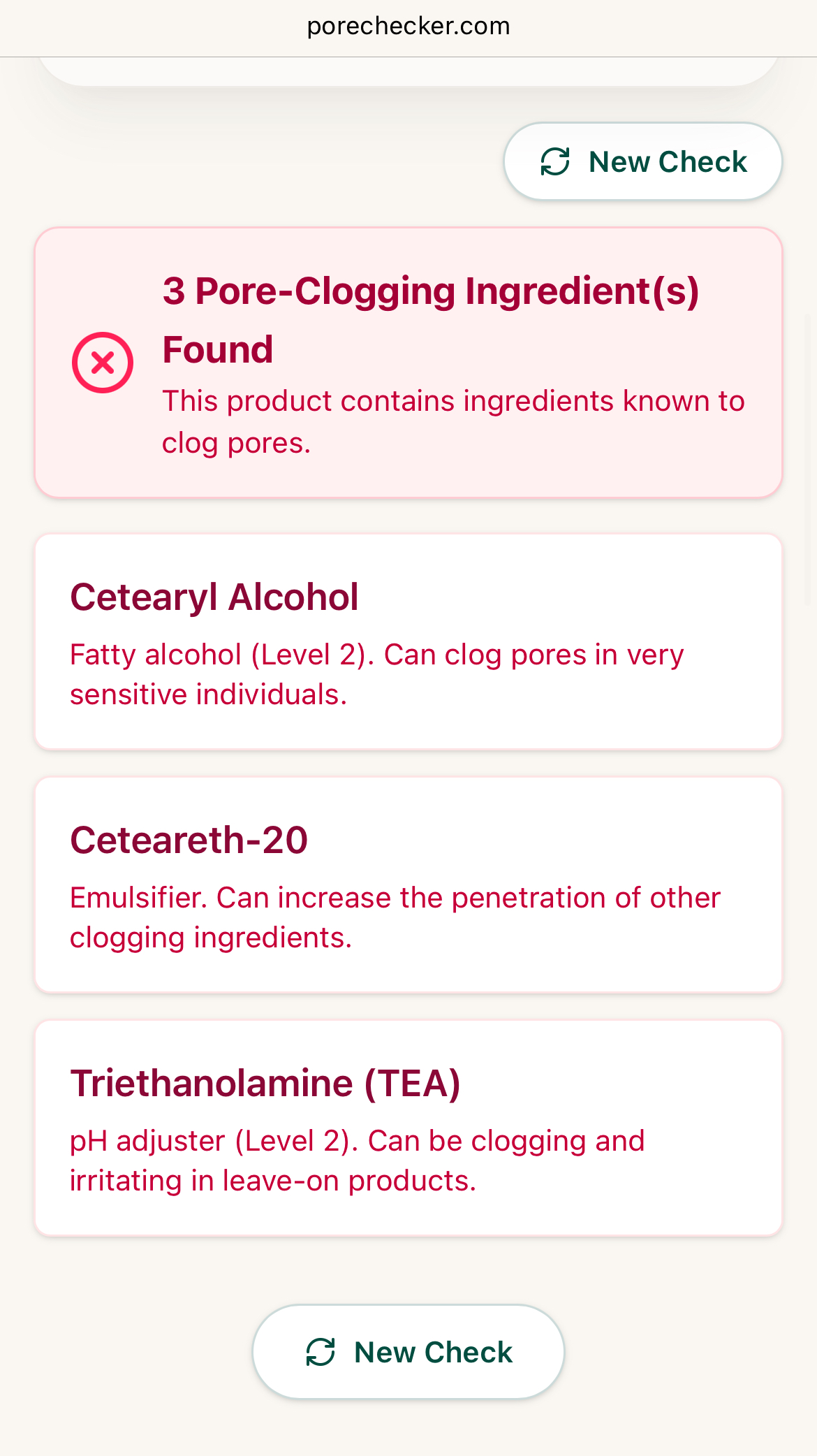
You get an immediate breakdown. If any red-flag ingredients are found, we highlight them and explain why they might be problematic for your pores.
Does this product fit my skin's needs?
Check Your Products Now