What Does Acne On Your Forehead Mean for Your Skin Health?
Frustrated by breakouts on your brow? Learn what does acne on your forehead mean, from hair care triggers to non-comedogenic care.

When you notice an eruption of bumps across your hairline or center-forehead, it is natural to search for a singular cause. While historical mapping techniques—often known as "face mapping"—suggest that forehead breakouts are linked strictly to digestive health or stress, dermatological science offers a more nuanced view. Forehead congestion is almost always the result of a direct interaction between your skin’s barrier, your hair care habits, and the topical agents you apply daily.
Understanding what does acne on your forehead mean requires shifting your focus away from internal myths and toward the external factors affecting your follicular health. The skin on the forehead is part of the T-zone, an area particularly rich in sebaceous glands, making it highly susceptible to comedogenesis if the surface is consistently occluded by heavy, pore-clogging substances.
The Role of External Occlusion
The most common culprit behind localized forehead acne is product migration. Your scalp is home to a unique microbiome and a high density of oil-producing glands. When you use styling pomades, heavy conditioners, or leave-in serums, these products often travel downward. As they sit against the skin of the forehead, they create a physical seal that traps sebum and dead skin cells within the follicle, leading to the formation of micro-comedones.
Beyond hair care, sweat and friction play a significant role. If you wear hats, headbands, or have bangs that sweep across your brow, you are creating a micro-environment that encourages bacterial growth. These accessories act as a trap for sweat and oil, essentially creating an incubator for acne-causing bacteria. Maintaining a non-comedogenic routine is not just about your moisturizer; it is about auditing everything that comes into contact with your face throughout the day.
Identifying Hidden Pore-Cloggers
Many consumers inadvertently sabotage their skin by utilizing products that claim to be "dermatologist tested" while simultaneously containing ingredients known to be highly comedogenic. Ingredients like coconut oil, isopropyl myristate, and certain heavy silicones can appear in hair care and facial sunscreens alike. When these ingredients settle into the skin of the forehead, they can trigger a delayed reaction, leading to deep, persistent bumps that refuse to resolve with standard spot treatments.
Don't Let Your Products Ruin Your Progress
Even with a perfect cleansing routine, you might be fighting a losing battle if your daily lineup is working against you. Many seemingly gentle formulas contain hidden pore-clogging agents that disrupt your skin's equilibrium, turning a simple skincare regimen into the primary source of your forehead congestion. The most effective way to address persistent breakouts is to scrutinize your product ingredient lists for those specific culprits that trigger comedones. By utilizing a professional ingredient checker, you can take the guesswork out of your routine and ensure every item you apply is truly compatible with your skin, finally allowing your barrier to heal without the constant threat of renewed occlusion.
Step 1: Upload Your Product Image
Simply snap a photo of the ingredient list on the back of any bottle, jar, or box. No typing required.

Step 2: Instant AI Ingredient Analysis
Our advanced AI scans the image, performs OCR (Optical Character Recognition), and matches every ingredient against our curated database of comedogenic substances.

Step 3: Clear Results for Clearer Skin
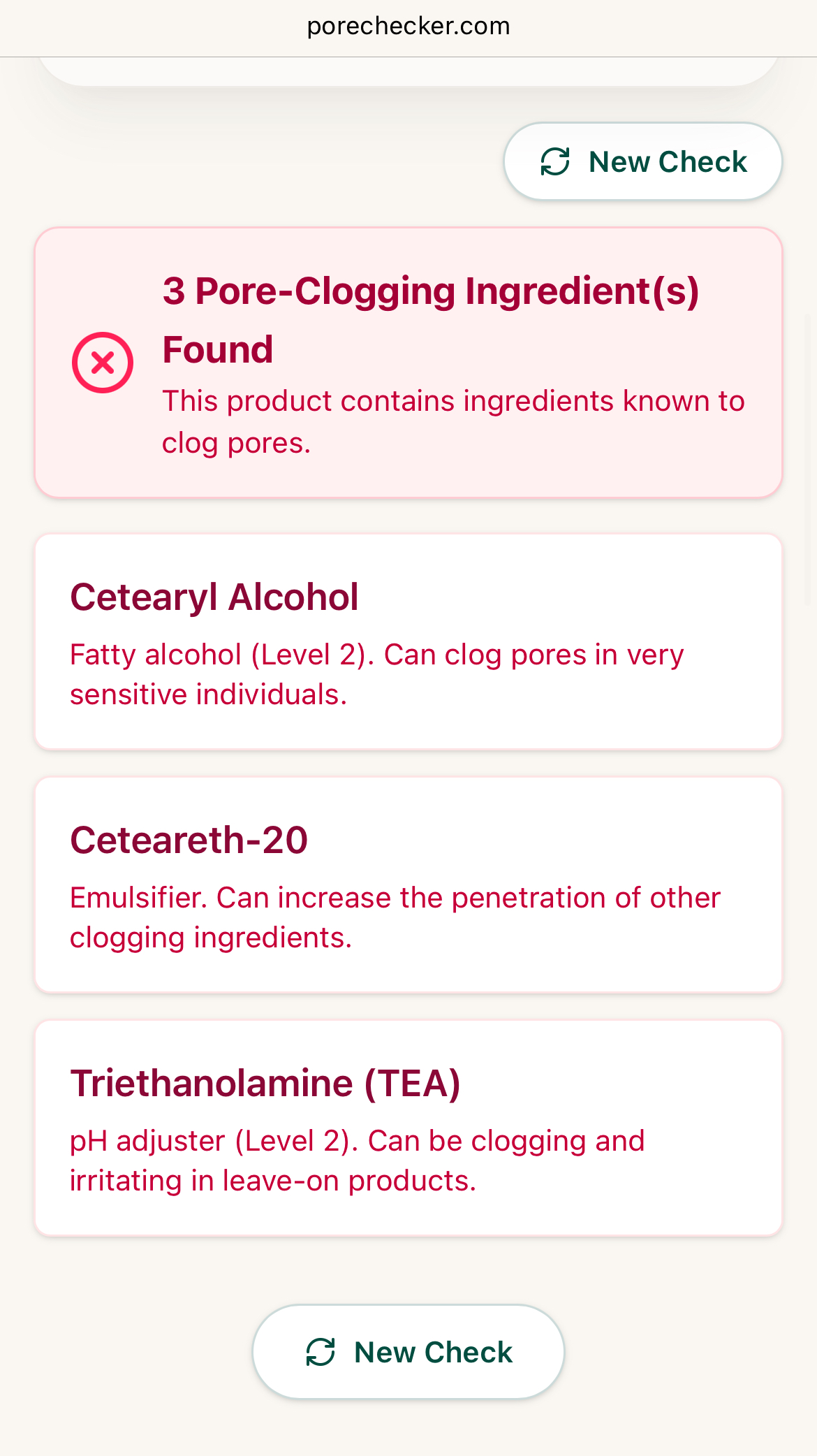
You get an immediate breakdown. If any red-flag ingredients are found, we highlight them and explain why they might be problematic for your pores.
Does this product fit my skin's needs?
Check Your Products Now